👋 Hey, I’m Jaryd. I share one stealable idea with you a week on product, growth, AI, marketing, or strategy. My goal is to help with the hard part—growing the thing you’re trying to build. For more: Explore all ideas | Follow me on Instagram
Today's Idea, brought to you by:
 |
Hey100 — find users, meet founders, get great feedback I'm a builder & want to reach more users |
Software has never been copied or reverse engineered so quickly.

Artcraft AI reverse-engineered Adobe: duplicated 7 of their main apps in a month, made it open source.

My friend Aakash Gupta built his own version of Linear as a demo, just to show how easy it was.
I essentially remixed a version of the 1SE app with Little Moments.
Everyone is cloning everything either for just themselves, or to profit.
No UI/UX or set of features is safe.
beehiiv as a joke did this. But all jokes come from a place of seriousness.

So, with knockoffs of everything everywhere all at once…does that mean software is dead?
Definitely not.
Features and code in software are just not the moat anymore.
In response to Marc Lou making his own beehiiv and then charging people for it, besides that cheeky billboard, Tyler Denk wrote a great reply piece on the problem with vibe coded software.

And his main point is true, right now the surface can be copied very easily. But the cost of maintenance and all the years of expertise around workflows, weird edge cases, and hard problems is hard to copy.
But he’s wrong that it will continue to be. I’ve been using AI to make products for 2 years and the change in quality, speed, and accuracy of what Claude can do for me now in my Cursor IDE is insane. I really do feel like Thanos.
So do you think in 2 years agents won’t be solving those types of problems for us?
Which is why I think that in software, there’s no lasting moat that can be found anywhere in the codebase.
Especially when you consider this r/SaaS post from the guy who reverse engineered Adobe
If you're worried this is just some one-off flash in the pan that will die, it isn't:
I'm not just some casual vibe coder. I'm a 15-year industry veteran who has written everything from six-nines payment rails that move billions of dollars of transaction volume a day to advanced robotics and optics automation. I've used Rust extensively for about a decade, and I know how to build and maintain large-scale Rust projects.
Simply put, companies don’t just have to be worried about LARPing devs like me with Max subscriptions.
So, the question becomes, if you can reconstruct a $5b app in a few hours with $100 of tokens...where does the value live? Who the hell do you bet on and why…and how do you build any defense for yourself?
I’ll tell you, but first please check out my app if you’re actively building someting👇.
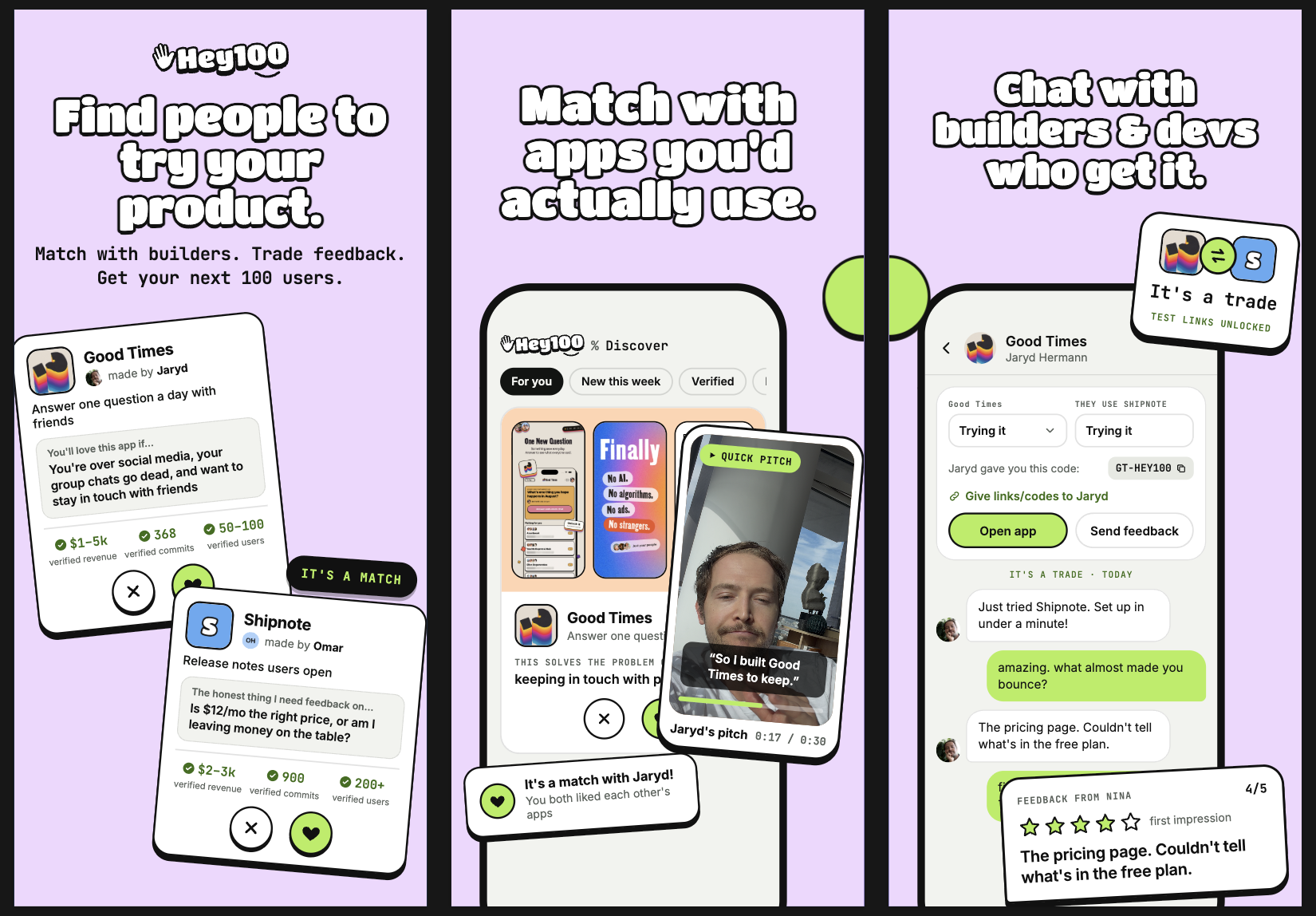
Btw to those of you who are on the list, I’m waiting for App Store approval. I’ll message you ASAP.
Be the one who does high manual effort stuff
Greg Isenberg recently said this after he “spent 48 hours running around San Francisco with billionaires, execs running AI companies worth anywhere from $1B to $100B and a lot of AI builders.”
The founders I'd bet on are shipping things that take three to six months and depend on relationships that are hard to replicate.
In other words, the moat is manual effort and time it takes to build real relationships with customers and partners.
And that's why partnerships are so back.
In my day job, I run consumer product for a travel tech company. We sell travel products: hotels, flights, cars, packages, tours, activities, cruises, etc.
The products on the surface aren’t that complex. A search box, some results, a checkout. You could vibe something gorgeous that looks like most travel sites in an afternoon.
We see this all the time, but it’s irrelevant.
The complex part is underneath. It’s the business relationships. The partners and airlines that give us inventory to aggregate, and the commercial contracts that make the rates worth booking. You don’t see that in Twitter screenshots with captions saying “I cloned Expedia this weekend”.
No, you didn’t. No inventory deals, no contracts, just a pretty layer on top of someone else’s API that could disappear tomorrow.
That’s because partnerships are a moat.
The proof of “We’ve partnered with __”
Lovable added roughly $100M in annualized revenue in a single month back in March, mostly from people shipping apps that didn’t exist the week before. When anyone can build the thing, the thing stops being the advantage.
But it’s not just that, there is now SO MUCH out there that actually looks good at the surface and makes claims. A few years ago you could open a website and tell at a glance by the design and just the vibe if it was a real product or not.
Now you can easily look like a real product with good design, avoid AI-isms, but have a crappy foundation behind it without a user checking you out and having a clue what’s real.

Which is why “we’ve partnered with X” is back to being a real signal.
Because partnerships with a hospital system, a manufacturer, big retailer, pharma company, travel OTA, a bank, or even a big tech company can’t be cloned over a weekend.
Not just because of the human effort and time it takes to build, but because good companies that make good value-add partners don’t just shake hands with anyone who asks nicely and with a thorough Claude-written application.
Small example: I wanted access to Resy’s API to build a date planning app (I’m sure many of you remember Dateful). I didn’t meet the requirements, and that deterred me from continuing my build.
This means a partner is a co-signer. They check your volume, your tech, and decide whether you’ll still exist next year. So when a serious company puts its name next to yours, it tells people something your landing page can’t: someone with something to lose already checked you out.
Which means when customers and investors see that link or announcement, it’s a proof point to the quality and team behind the product.
You can’t fake, unless you’re Elizabeth Holmes, six months of legal review, integration work on both sides, and getting a partner’s sales team to actually mention you (anyone who’s done co-marketing knows a single joint blog post takes three weeks and 32 Google Doc comments).
Distribution is the hardest it’s been in years
And partners can come with distribution attached.
ElevenLabs could’ve sold to every enterprise one by one. Instead it launched on the Google Cloud Marketplace, so customers can buy it on the cloud bill they already pay, with procurement and compliance already sorted.
You’re not just borrowing a logo, you’re borrowing their reach and checkout.
So yes, they take time and effort but once you have them you get help with the hardest part of building. Which is why teams who take 3-6 months building and investing in building with partners have a much better shot at growing.
Hiring is has tripled
Always follow the smart money.
Companies are ramping their hiring to build partnership teams.
And not small companies fighting for relevance, but Anthropic, Supabase, Lovable, ElevenLabs, RevenueCat and many more.
In 2022, there were about 18k jobs in the space. This year: 58,000 with integration and platform partnerships growing fastest.
That’s up ~3x and it lines up pretty well with AI models getting better. Because when everyone can do the easy thing, bet bigger on the high effort thing.
Attio is paying $175k–$240k plus equity for Product Partnerships. The job is to go after the category-defining tools their customers already use, own those relationships and lead the co-marketing.
Alloy.ai wants a Head of Data Partnerships ($175k–$225k) who can structure deals around revenue share, data rights and exclusivity. That’s a dealmaker.
Conveo is paying $160k–$260k for a Head of Partnerships and says partnerships are small for them today but will become one of their core revenue sources.
Ok, but how do I make a partnership happen?
You’re probably not getting a call back from a hospital system next week. Fine.
Here’s how I’d start if I wanted one. And yes, manual effort is needed.
I’d list the 5 tools my users have open all day and work backwards. Start from user value.
I’d lean toward the threat. If agents or a bigger platform could replace me, I’d be the thing they plug into.
Find out who runs partnerships. Apollo, LinkedIn: find and connect with them. Read up on the partnerships they’ve led, and why they did. Avoid the generic apply flows, ask them personally and make it clear you are not selling anything. I’d use a Loom video.
Bring a co-marketing plan. I’d write a launch post, a template, a shared customer story about why people want this. Partners say yes to things that make them look good not you.
Bring a demo. Some more engineering-forward companies have sandbox APIs. Use them to build mini demos and make Loom videos to show them what you want to do.
Start with the smallest. Small logos compound. If you partner with little x, it’s easier to partner with big X.
You don’t need the biggest partners to get the value of a partner. As long as you’re getting something you can’t build yourself (inventory, data, rights, distribution) and importantly: it shows up in your product to make your product actually better.
Anyone can clone your product this weekend. So, what’s the relationship that would take them six months to copy?
—Jaryd
beehiiv just gave me beta access to this new feature called Tip Jar. This is cool!
|