👋 Hey, I’m Jaryd. I share one stealable idea with you a week on product, growth, AI, marketing, or strategy. My goal is to help with the hard part—growing the thing you’re trying to build. For more: Explore the top ideas | Watch me yap
Today's 5-Bit, brought to you by:
 |
RevenueCat — App Growth Annual is next week Watch free online |
 |
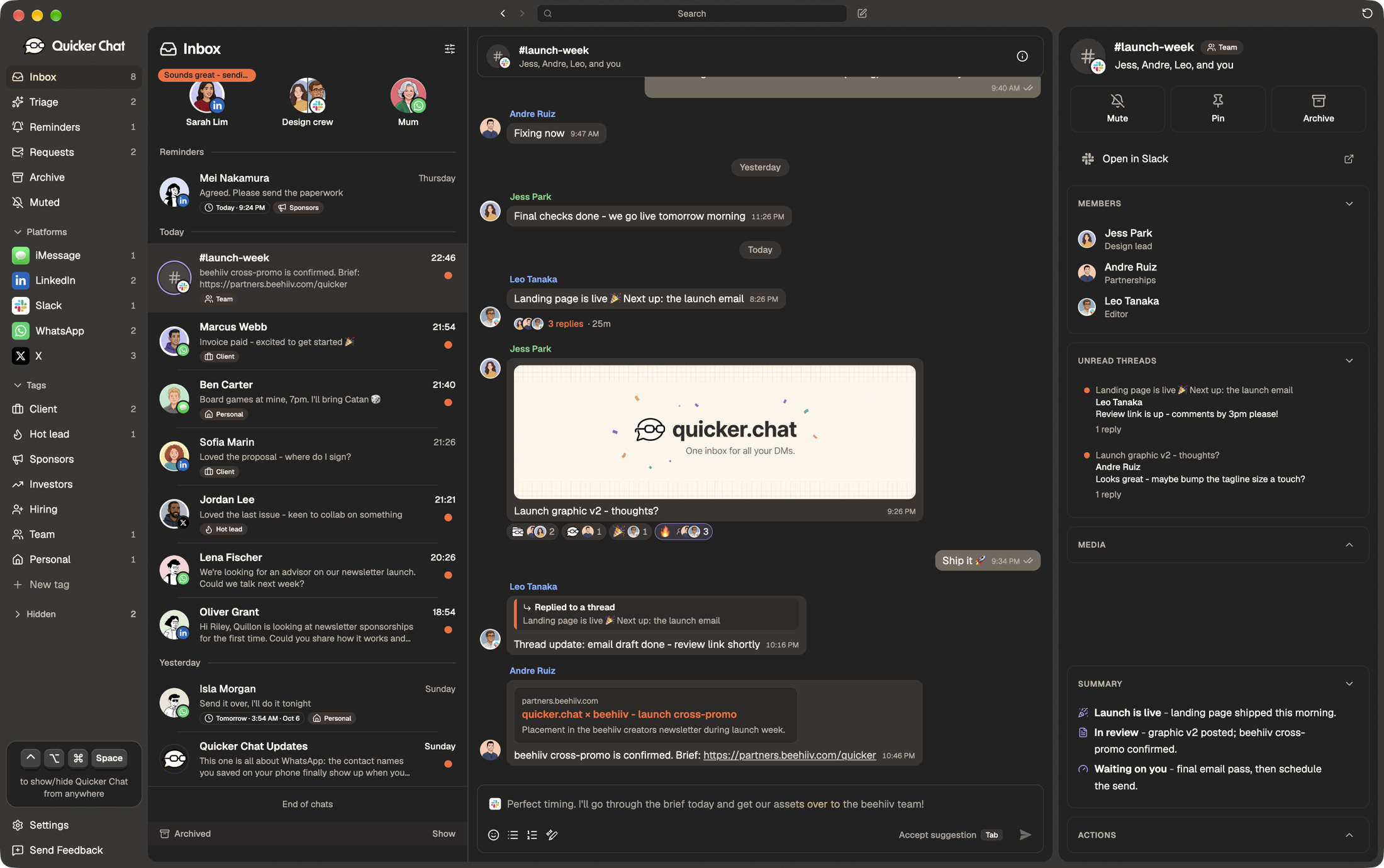
quicker.chat — one inbox for all your DMs I want all my DMs in one place |
Good morning guys, and happy Friday!
Does this resonate with you? You build something cool, but struggle to get people to discover and use it? That finding good users and getting good feedback is hard, especially in the beginning?
The problem “I want to find my first 100 customers” is real, at least to me.
So, I'm doing some research with an idea in mind—if you’re building something, and would like to be looped in and possibly be an early design partner working closely with me and a few other builders, just tap yes here👇
Are you interested in finding your next 100 customers?
or hit reply to this email

What if every app was built just for you?
What's going on: As of this week, anyone with a Google account can vibe their own Android app in Google AI Studio and run it through Google Play. The apps are private and “just for you”. Sharing with small groups is coming soon though.

Why it matters: Google has always made it a pain to list an app with way more steps than Apple. Now, the biggest app store in the world is authorizing an audience of one. It’s a shift from “there’s an app for that” to “there’s an app for me.” If building your own bespoke app is so fast and easy, a lot of small/niche apps lose their reason to exist. Someone even told me, “Why would I pay for your app [Little Moments] when I can make it myself?”
The idea behind this: Product risk is real. Yes, people can rebuild your product. Should they, and is it worth it? That’s not the point. But it does mean the better thing to sell is what took years to build: your expertise, data, network, and taste.

Why the bundling of Grok, Cursor and X?
What's going on: We now have “The X Subscription”, which folds Grok, Cursor and X Premium into one plan with four tiers: Plus at $8, Premium at $30, Super at $100 and Ultra at $200. The marketing angle is the $30 tier replaces about $90 of separate subscriptions. Also Grok and Cursor now share one usage pool.

Why it matters: We’re seeing the cable TV playbook come to AI. Separate products → one bill → price it lower than the sum of the parts. It makes cancelling harder because you’d lose three things at once. The shared pool also matters, with chat and code drawing from one budget it makes it easier for X to upsell you.
The idea behind this: X won’t beat Anthropic or OpenAI, so if you can’t beat the leaders on one product, make a compelling whole package. If you missed the idea on cross-bundles, check it out

How does a free leaderboard make $100M a year?
What's going on: Arena is that site where you compare two anonymous AI models and vote for the better answer. They’re annualized revenue went from $30M in Jan to $100M by June. The leaderboard is still free. So, where does the money comes from? AI evals, which tests models with the same community voting.
Why it matters: Every free vote builds the dataset the paid side sells. Labs want to know how real people rate their models, and Arena owns the biggest pool of those ratings. The free leaderboard is also its marketing, where every lab brags about its rank, which then sends more people back to vote. A nice growth loop.
The idea behind this: Give away the thing that creates your proprietary asset. If your free product produces data, rankings or reputation that only you hold, let users pay with their attention and monetize the businesses side.


Do agent teams work better than one agent?
What's going on: When you code with AI you can use one agent, or have teams of agents working toward your goal. An analysis compared which is better. In short, teams cost up to 5x more, yet only 25% of teams showed any difference in work quality.
Why it matters: Word on the street is if you’re not using more agents to do the job you’re not doing it right. That more agents means better output. In this data though, most of the extra money went to the agents coordinating with each other. Generally speaking for cost, letting one agent think longer did better than splitting the work.
The idea behind this: There’s a good analogy here to hiring humans. Before adding more heads, give the one you have more time and focus and freedom to do the work. Coordination costs something, IC’s by themself often do better than teams trying to get the job done. It might pay off only when the work actually splits.

Can a vibe-coded launcher beat Steam?
What's going on: Epic released a preview of its rebuilt PC launcher. Except this one had one tiny team rewrite it from scratch. Epic proudly call it vibe coded. By Epic’s own tests it cold-starts 46% faster and loads your library 15% faster. It also runs on Linux for the first time.
Why it matters: Most companies that size would by hide that AI rebuilt their flagship moneymaker, yet Epic headlined it. Almost with a pride and confidence in their moat, the catalog. AKA feel free to copy it, you still can’t beat us.
The idea behind this: Instead of patching old code that everyone hates to touch, maybe just rebuild it? And how you propose rebuilding something can even be part of the pitch. A faster product built by a tiny team is a good story.
That’s it for this week. And before you go, if you didn’t answer before…
Are you interested in finding your next 100 customers?
—Jaryd
|