👋 Hey, I’m Jaryd. I share one stealable idea with you a week on product, growth, AI, marketing, or strategy. My goal is to help with the hard part—growing the thing you’re trying to build. For more: Explore the top ideas | Watch me yap
Today's 5-Bit, brought to you by:
 |
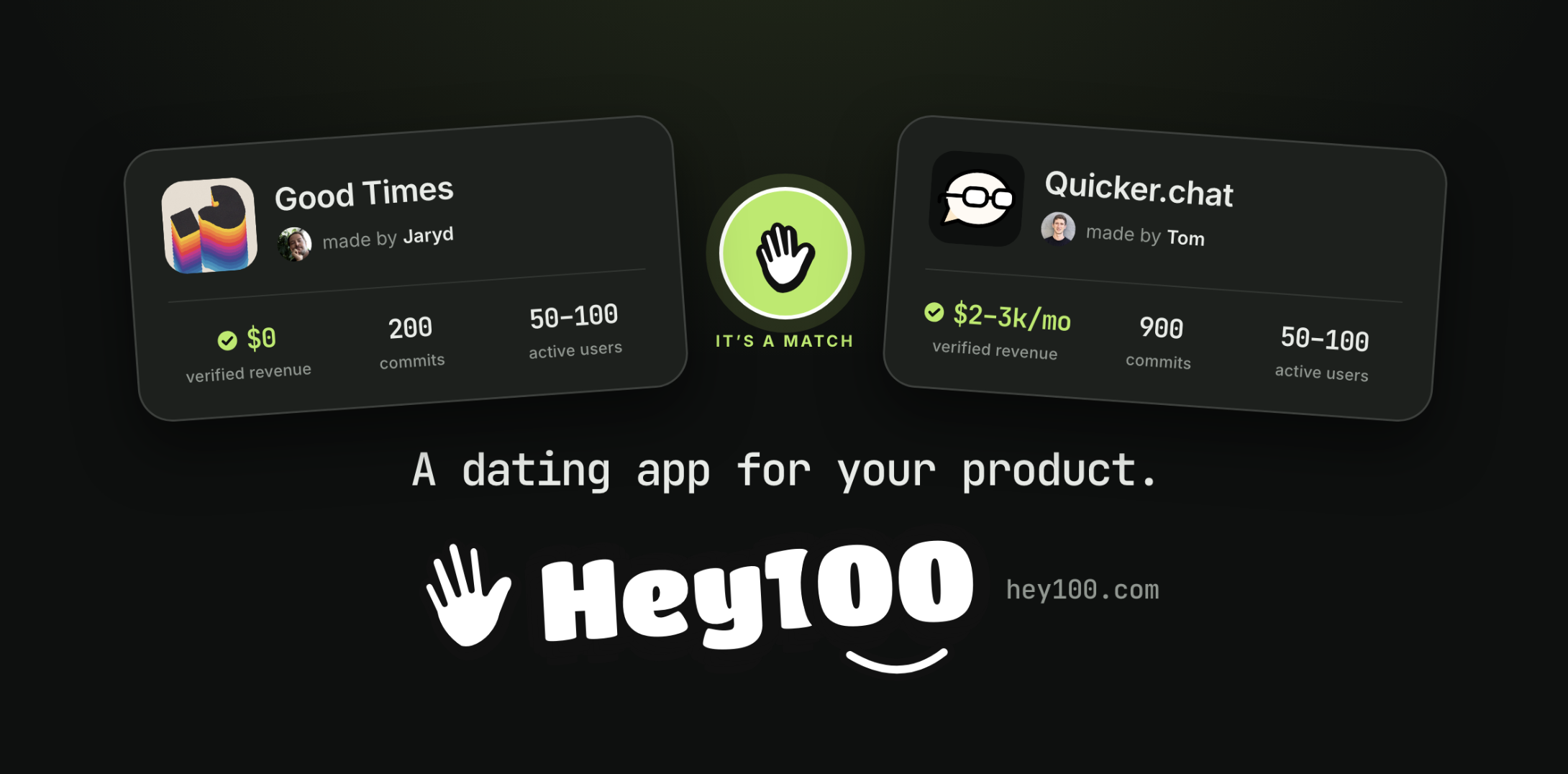
Hey100 — find 100 people to try your product I've been struggling with user growth |
 |
RevenueCat — build, manage, and grow your app business Grow my subscription revenue |
Good morning guys, and happy Friday!
I overslept this morning and that’s when I write the opening blurb. No time now, I need coffee. So let’s just get right to business. This is a good one ☕

What do Elizabeth Holmes and Elon’s flying car have in common?

i was on the edge of my seat for 3 hours
What’s going on: Last Thursday we had a lovely serendipitous moment. The flying Tesla and first public screenings of You Can See Everything, which is Nathan Fielder’s film on Elizabeth Holmes. It’s ludicrously good, probably in my top 4 films of all time. Is her “faith-in-the-tech” style becoming more the norm?
Why it matters: The “flying car” won’t be in production until at least 2028, and that flying version is invite-only anyway. Musk isn’t lying, more just asking you to accept delivery as an article of faith. In a lot of ways now, AI is like that—a faith-based technology. Lots of people said about Therano's that a blood-testing product will come along (you been seeing those Rythm ads everywhere?) and make Holmes look 20 years too early. In tech, the builder is never wrong. Just early.
The idea behind this: Vision sells. Selling the future is fine and right. But pretending it’s already here is the problem. On Tuesday I wrote about why the flying car works: it’s a real thing clearly labeled as not for sale, parked next to the car you can buy. Theranos sold a machine that didn’t work and called it shipped. TLDR be bold and loud about where you’re going—what something can one day be, but be clear about what’s capable today. As the film shows…words matter.

Just because you can vibe-code your stack, should you?
What’s going on: Indie-hacker Marc Lou tried to “clone” beehiiv. Tyler Denk, the CEO of beehiiv, wrote a hit piece back on building vs buying. Lovely online banter I’m here for. In short he reminded Marc that in 2009 Thomas Thwaites built a toaster from scratch. It took him 9 months, cost 250x the store-bought version, and worked for 5 seconds. Then this week went ahead and proved his point with a wave of critical security flaws impacting 70% of the internet.

Why it matters: Yes AI means you can make whatever toaster you want…and I made plenty…but should we? Take newsletters, you’d still be paying for sending, hosting, auth, bot protection, email validation, monitoring and more if you cared for it to be decent. Building is cheap, but owning it forever is expensive. Plus, when you vibe code your stack you’re also its head of security now. And AI made attacking cheaper too, so more chance you and yourself have to scramble with Claude to fix shit.
The idea behind this: Be clever about what’s worth making for yourself. My rough rule is to build the stuff that’s your edge, like the weird internal tool or the workflow nobody sells, and rent the stuff that’s someone else’s entire job. If it breaking at 2am would cost you customers pay the people with 130 specialists on call.

Where’s the whitespace now that the computer is being rebuilt?
What’s going on: Greg Isenberg spent 48 hours in SF with AI founders and lab leaders like Jensen Huang. He walked out and wrote to us that the model is the CPU, the harness is the operating system, and skills and plugins are the apps. A few with billions are fighting over the CPU. The OS and the apps (as I wrote before) are wide open. One AI founder told him the model is maybe 20% of the product. The rest is industry data, evals written by experts, rules for what the agent can touch, and a good UI for a human to review the work.
Why it matters: If skills and plugins are the new apps, then skill directories and plugin marketplaces are the App Store in 2009. Back in August, ChatGPT’s app directory had ~1,600 apps in front of 800M weekly users. Most categories still have nothing great in them and the shelves are empty.
The idea behind this: I’d run the test someone asked Greg’s dinner table: if a new model drops next month, does your company get better or worse? Half the table apparently went quiet. If a better model makes your thing better, you’re building on the right layer.

Why is everyone deleting their Claude setup?
What’s going on: Since Sept 16, Claude’s Chat and Cowork have been one box. Ruben Hassid’s new guide says to go further and delete your old setup—all the instructions and about-me’s and skills and folder protocols. To quote Boris Cherny who made Claude Code, “delete your CLAUDE.md, skills and hooks every 6 months and see what the model does on its own.” Hmm.

Why it matters: This is the constraint idea coming full circle. First Anthropic took away the choice of where to work, now users are taking context away from Claude. A bloated Claude setup is like briefing a consultant with your whole CV and portfolio and personal manifesto for life before every single meeting. The problem is they end up thinking about you instead of the problem and goal. And that might sound like it contradicts what I just said above, but it doesn’t. Skills about you are bloat. Skills about the work are the product.
The idea behind this: I’m stealing two things from Ruben’s guide. #1 is your prompt, which should have your goal, your context, then the line “Before you start, restate in your own words what you think my goals are.” If Claude misread you you find out in 10 seconds instead of 30 minutes and wasted tokens. #2 is a neat trick → ask for “Make it an HTML page” instead of a Word doc or a PDF. A file sits in your Downloads as report_v3_FINAL.docx. A page lives in the cloud, opens on your phone, shares as a link, and Claude keeps editing it when you ask.

Can you buy day 14?
What’s going on: Two weeks ago we looked at how Muse hit 5M downloads in 22 days because Meta pointed a ton of its own ad slots at it. We have some follow-up numbers. Muse hit 10.2M US downloads in 40 days which made it the 11th app ever to do that, and Meta put 39% of its October ad spend behind it. The retention curve though. D1, 73% versus 41% for ChatGPT. Nice! By days 8–9 though ChatGPT had caught up. By day 14, Muse was behind at 22.5% and ChatGPT at 26.8%. For context, WhatsApp keeps 67% of users at day 14.
Why it matters: While distribution can buy you day one the product has to do the work to keep people there by day 14. Meta’s reach inflated the start of the curve, now we have a better idea what it’s worth to people. Muse is still beating the average AI app and I think it’s great as, but the first 48 hours of numbers told the wrong story.
The idea behind this: Judge your launch by where the curve flattens, not how high it spikes. “Use every surface you own” is still the right move for getting the first date with people, without a doubt, it just can’t get you the second one.
That’s it for this week guys! I’m here in the inbox to talk about a) the movie if you’ve seen it (what did you think!?) or b) Hey100.com and what your thoughts are. I’d love to work with you on it.
—Jaryd
p.s I found this really fun game called Krillion.io → everyday you get 6 random questions and you test your knowledge by trying to give the most uncommon answer. The more uncommon knowledge you have, the “deeper you dive”. It’s surprisingly additive. Totally free, give it a play and see how you do! I just got 3,100m and played better than 70% of players. Give it a try!
|