👋 Hey, I’m Jaryd. I share one stealable idea with you a week on product, growth, AI, marketing, or strategy. My goal is to help with the hard part—growing the thing you’re trying to build. For more: Explore all ideas | Follow on Instagram
Today's Idea, brought to you by:
 |
HubSpot for Startups — a free ChatGPT Ads guide Get the free guide |
 |
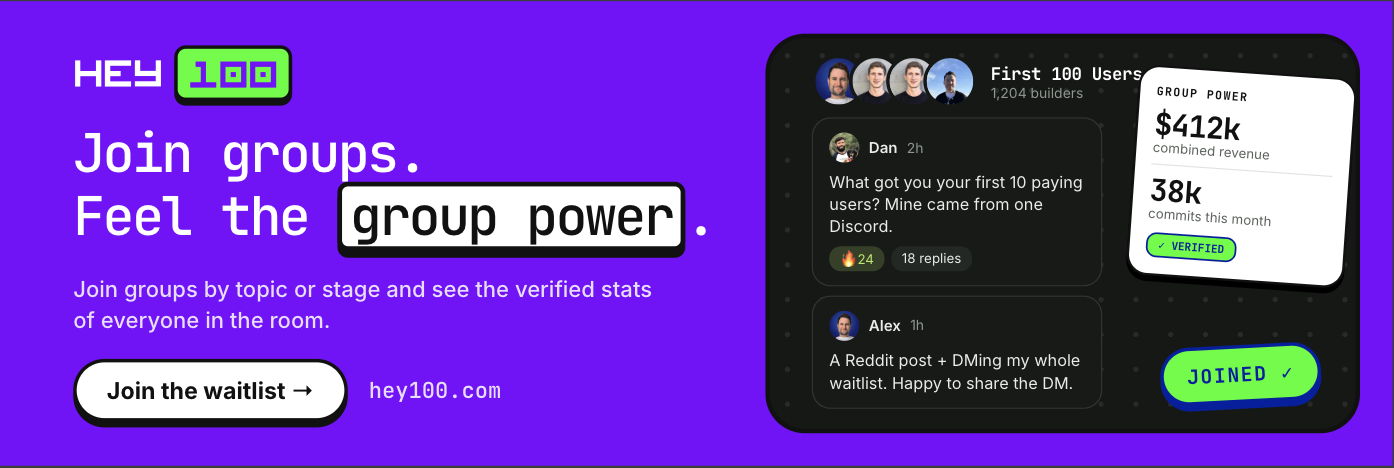
Hey100.com — find users, meet founders, get great feedback I'm a builder & want to reach more users |
Picture the best taco spot in Brooklyn.
Tortillas pressed by hand every morning. Salsa from someone’s granny. A chef who really cares. But there’s no sign out front, no menu in the window, no Google listing, zero reviews, and the door is down an alley that looks like the shortcut to a dumpster.
So who eats there? The chef’s friends. Maybe a neighbor.
That’s a lot of products right now.
Poor sales rather than bad product is the most common cause of failure.
And AI is making a new generation of founders who love to build, but hate to sell. Simply, because AI has made building addictive. Building is the fun part. Shipping a feature feels like progress, always adding something else new because we can, leaning into a tad more perfection before putting it into the world. The building is comfortable and the growing is not, which is why so many builders (myself included) jump to new ideas…to get that dopamine of the early build…but never the full payoff of the outcome of getting actual users.
But it’s not just “poor sales” that stops growth. To grow, a good product needs 8 different things working together. This is something I’ve noticed based on the following personal experiences:
Being in product for 10 years
Being a product leader at a $1b company
Running a suite of consumer travel products today
Starting a company, growing it to $2m, and selling it 4 years later
Studying companies and writing about product/growth here
Making 3 apps that have made $0 so far
I put a 30-second version of this observation on Instagram and it did well, so here’s the full version. 👇 But first, a quick word from HubSpot for Startups.
1. Without marketing, nobody sees you
Nobody is refreshing Product Hunt waiting for you to launch. There’s a big study of ad effectiveness—the IPA’s look at 996 campaigns over 30 years—and they landed on roughly 60% brand building to 40% sales activation as the sweet spot. AKA even the performance-marketing crowd needs the slow, boring “who are these guys” work running in the background.
Here’s what I’m doing for hey100 right now: going deep on Reddit. My strategy is not dropping links that gets you banned. Commenting, DMing, adding to other people’s threads, and adding to the comments on my general community posts. I’ve posted twice. Both got over 10,000 views and one hit 52,000, and I didn’t mention a product once. I just talked about the problem. And for the people who engaged specifically, I move that to the DMs and my product shows up later.

How
→ Write the one sentence first. Who it’s for, what it replaces, why now. If you can’t write that out then you got work to do, no channel will help you yet.
→ Pick one channel and get it to actually work before you touch a second. It’s tempting to go to many places, but most businesses get zero channels working. One working channel is a great business and its hard enough, so beat that dead horse.
→ Spend time before money. 20% of your week in the place your users already hang out. Again, for me that’s Reddit. Yours might be a Discord, a subreddit, LinkedIn.
2. Without content, nobody hears you
Marketing gets you the glance. Content gets you the second one, and the tenth. Zapier is the classic, their blog alone pulls in millions of organic visits a month on top of tens of thousands of programmatic “connect X to Y” pages. None of it needs an ad budget to keep running. And content is also what the AI search engines are reading when someone asks “what’s the best tool for ___”, and that matters more every month.
My content for hey100 lives on my Instagram. My personal brand there is doubling as the marketing channel, but the real job is taking the ideas and problems I keep hearing on Reddit and in DMs and experienced myself building, and packing them into reels. One problem, five different 30-second angles. The Reddit threads feed the reels and the reels feed the waitlist.
I just started posting content and here are here’s some early data.

How
→ Pick one format, one channel, one cadence, and run it for 6 months. That’s my IG commitment.
→ Most ideas for content can come from what your customer ask in onboarding or bring up in calls. People often grab at the universe for ideas of stuff to talk about but your content pool is already sitting in your support inbox (or your Reddit replies).
→ If you have structured data (integrations, templates, comparisons, locations), build the pages programmatically. “X vs Y” and “X for Z” is cheap traffic and Claude can make them for you.
→ Cut one long thing into five short ones. Every Instagram Reel of mine that works, I repurpose it into 5 different posts. Double down on winning ideas.

3. Without branding, nobody chooses you
When two products do the same thing people pick the one they recognize and feel something about. Liquid Death sells water in a can. It did $263 million in retail sales in 2023 and raised at a $1.4 billion valuation in March 2024. The product is water and water is water. The brand is the entire business. Branding is the tiebreaker in the shelf, and for us features are the same more than ever.
Small version of the same thing: I recently redesigned the hey100 site, and over 90% of people who land on it now join the waitlist. Not to toot my own horn, but the site is gorgeous and I’m very proud of it. The brand is doing a lot of the work of getting people to pick me.
How
→ Pick an enemy. Liquid Death’s is plastic bottles and boring. Yours might be bloated incumbents, agencies, spreadsheets, whatever.
→ Pick some things that you’ll never do, because constraints are how you build brand. It makes a personality for your brand.
→ Stay consistent for longer than feels comfortable. I am bad at this. I am always updating my things to look a little different. But consistency is what customers noticed.
4. Without design, nobody trusts you
People decide if your site is credible in about 50 milliseconds. Stanford ran 2,684 people through two live sites and 46.1% of all credibility comments were about the design look, more than any other factor. McKinsey tracked 300 companies for 5 years and the top quartile on design grew revenue 32 percentage points faster than their industry peers.
Anecdotally, I will NEVER use a product unless it looks great. I don’t want the association. We use products that we “see ourselves in”, and things that look good are more appealing to use.
Design is the proof you’re real and know what you’re doing.
Which brings me to the slop. AI will design for you now and it will look reasonable and that’s the trap. Too many people take whatever it hands them and think it’s fine. It isn’t. Everyone can tell it was AI-made without any human taste in about two seconds, and that is the fastest way to lose the trust you just read about. The bar for “this is a real company” keeps moving up precisely because anything can look decent in an afternoon.
How
→ Stop the slop. Be the hard judge. Build your own taste board of references and critique everything AI gives you against it. The tool is the junior designer. You’re the creative director.
→ Never, never, use AI photos of people. If you show people, show real ones.
→ Put your name and face on it. “Made by Jaryd.” I’m doing this on my own products now, and if you’re an indie dev vibe coding, it’s the cheapest trust you’ll ever buy. A real person behind the thing beats a faceless logo every time.

→ Fix the first 5 seconds: above the fold on your landing page, screen one of onboarding, and your empty states. That’s where trust is won or lost.
→ Steal a system instead of inventing one. shadcn, Tailwind UI, Apple’s HIG. One font, two colors, one button style. Nobody gets credit for a custom dropdown.
5. Without distribution, nobody finds you
Marketing is the message. Distribution is the pipe it travels through. Alex Rampell at a16z said this, “The fight between a startup and an incumbent comes down to whether the startup gets distribution before the incumbent gets innovation”. TiVo had the better product. The cable companies had the box in every living room. TiVo lost.
How
→ Go where users already are instead of making them come to you. I’ve written about two of the biggest open doors right now: Apple’s cross-developer bundles and the emptiest channel with 800M users. Marketplaces, extension stores and other people’s newsletters count too.
→ Partner for a channel. Borrow someone’s reach and their checkout (the partnerships post, if you missed it).
→ Build the share into the product. For hey100 I’m building this in from day one: referrals that give each builder free matches for the day, groups people can share, a page for your product you can send around, shareable milestones, and badges you can copy onto your own site showing verified revenue, verified commits, and your hey100 activity (matches, heys, feedback). Every one of those is a reason for someone else to carry the message for me.
→ Own one channel and rent the rest. Mine is this newsletter. When I have open ad inventory I run house ads for my own stuff, the same way Meta runs Muse ads across its own apps. I wrote about why that works here. Rented reach gets more expensive the moment it starts working.
Just see the house ad I ran in today’s newsletter above for Hey100.
6. Without automation, nothing scales
Growth that needs you to show up stops when you don’t. WhatsApp had 55 employees and 32 engineers serving 450 million monthly users when Facebook paid $19 billion for it. Midjourney is roughly 40 people and north of $200 million in revenue with no outside money. That’s systems doing the work.
But there’s a catch and it’s the part people tend get wrong. Don’t automate too soon. Right now I’m working Reddit by hand, making the content by hand, replying and DMing by hand. Doing it manually keeps me close to what’s working and what isn’t. You automate a thing once you know it works, not before. Automate a guess and all you’ve done is scale the guess.
How
→ Manual first. Only automate something once you’ve done it by hand enough times to know exactly what good looks like.
→ Lifecycle emails next: welcome, activation nudge at day 3, win-back at day 30. They run forever and most products still don’t have them.
→ Put an AI agent on tier-1 support and on repurposing your content. Simple business.
7. Without innovation, nothing stands out
About 1 in 5 founders in CB Insights’ startup post-mortems said they got outcompeted. Parity is a slow death. You don’t win by being 10% better at the same thing, but by being the only one doing some specific thing. And the innovation doesn’t have to live in the code (we spoke about why that’s a bad place for a moat). It can be the pricing, the packaging, who pays, the workflow, the relationship.
It can also just be the UX, although that is a temporary booster vs an actual moat. Like a viral UI. Someone put the old iPod click wheel on the iPhone as a music player and did close to half a million downloads before Apple pulled it. Or solve the problem upside down: Roost Social is a messaging app where your texts get carried by a pigeon and take hours to arrive. While everyone else made messaging faster and easier, they made it slower and more limited and flew past 250,000 users. That stands out.
How
→ Finish this sentence: “We’re the only ___ that ___.”
→ Innovate on the model before you do it on features. Usage instead of seats. Free for the user, paid by the vendor. No feature innovation can stick around for long.
→ Ask what the incumbent can’t do because of who they are. Can’t go cheap, can’t go niche, can’t go slow. That’s a good lane to explore.
→ Ship one weird thing a quarter. A skin, a constraint, a UI nobody else would dare. Most will flop. One becomes the thing people know you for. PostHog are a superb example of this just go play with their site if you haven’t.
8. Without proof, nobody believes you
Claims are free so they’re worth nothing. Proof is expensive, so it’s worth everything. Products with 5 or more reviews are 270% more likely to be bought than products with none. And it scales with price, showing reviews lifted conversion 190% on cheaper products and 380% on expensive ones. The more you’re asking for the more proof you need sitting next to the ask.
One thing on what actually counts though. Posting your MRR chart isn’t proof, IMO that’s just marketing. Proof is what other people say about you. Testimonials, success stories, the message someone sent you. Qualitative beats quantitative here. “We save customers 80%” is a claim. “We saved Joe from Joe’s Pizza 80%” is proof and it’s about ten times more believable.
How
→ Ask within 24 hours of the “oh nice” moment. Right after people get the win with your product.
→ Make it specific. Numbers, names, faces. “Great tool!” is noise. “Cut our onboarding from 3 days to 40 minutes” from a named person at a named company is proof.
→ Screenshots count. A WhatsApp message or a text from a customer is proof. It doesn’t need to be a 2,000-word case study. Honestly, the screenshot is usually more believable than the case studies and people are more likely to read them.
→ Put proof next to the ask. On the pricing page, beside the signup button, in the checkout.
Score yourself
Give yourself a 0, 1 or 2 on each of the eight. 0 is “not doing it”. 2 is “killing it”.
I’d guess most of you are a 1 or 2 on product and a 0 on at least three of these.
Start with the 0s. Pick one. Get going on it.
—Jaryd
|